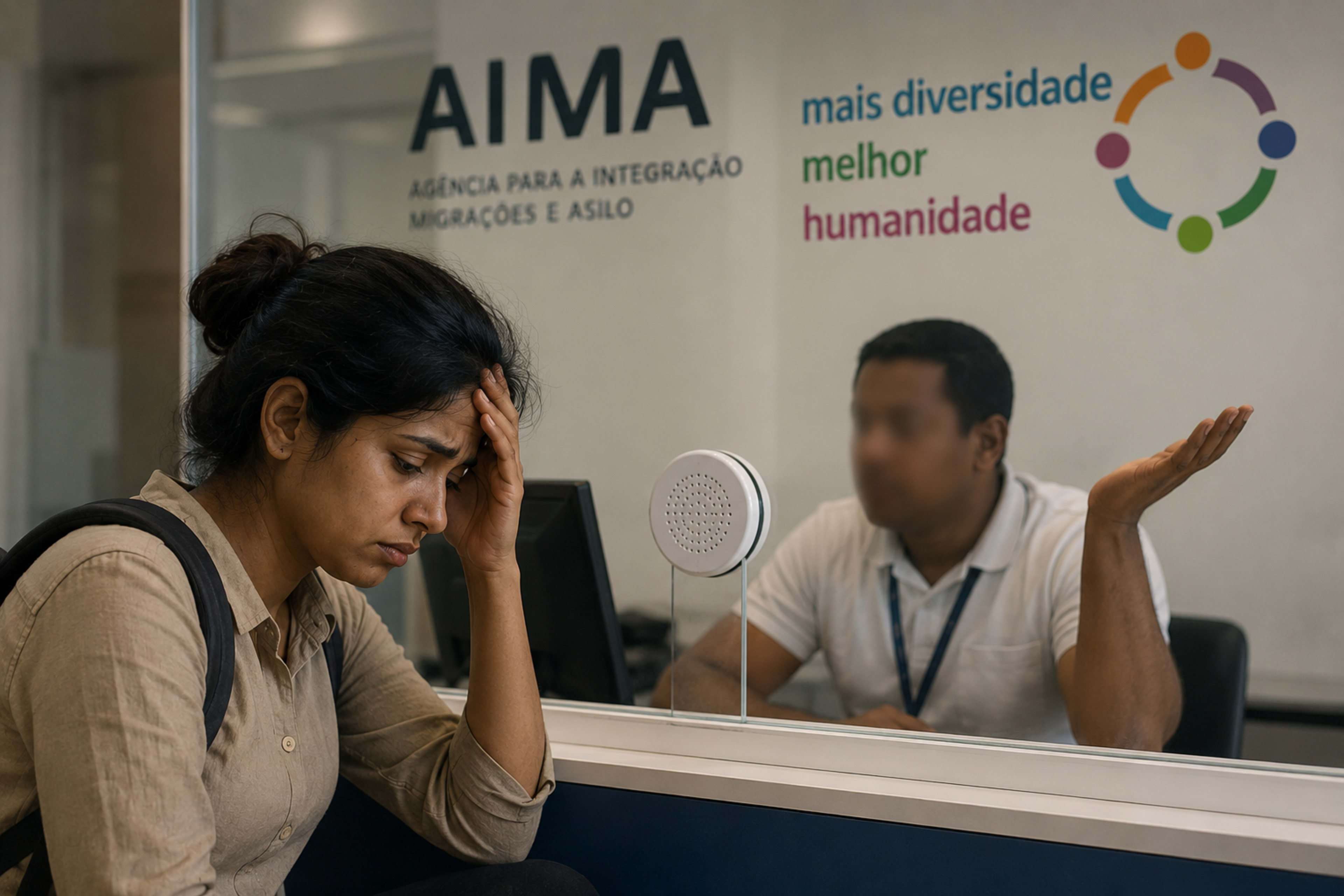
My experience during my visit to AIMA on 8 July was deeply
disappointing and distressing. As a researcher working on gender-based violence
and as a teacher, my time in Portugal is extremely valuable, especially because
I had limited availability for my fieldwork in India. However, due to the
delays and inefficiency of AIMA, my visit was unnecessarily prolonged, causing
further stress and uncertainty.
Mais diversidade, melhor humanidade
During my interaction at the centre, I experienced what I
perceived as a xenophobic attitude. What was particularly troubling was that
this response came from a person of colour themselves. Instead of receiving
support and understanding, I felt mocked for not being able to communicate
fluently in Portuguese. The experience was especially painful considering that
inside the AIMA premises there is a prominent quote: “Mais diversidade,
melhor humanidade” (“More diversity, better humanity”). This message
represents the values that a diverse society should embrace: respect,
inclusion, and humanity. However, my personal experience made me question
whether these values are truly reflected in the treatment of immigrants.
Portugal is historically a nation shaped by migration. Many
Portuguese families have members who have emigrated abroad, and therefore the
importance of migration should be deeply understood. However, the current
treatment of immigrants by AIMA often creates unnecessary anxiety, insecurity,
and emotional distress.
I applied for my residence permit renewal in February 2026.
My application was approved in April 2026, yet by July 2026, I still had not
received my physical residence card. According to the legal framework,
residence procedures should be completed within 90 working days. However, every
time I contacted AIMA through their helpline, I received inconsistent
information. Although the automated system states that English assistance is
available by pressing one, the responses I received varied each time, increasing
my uncertainty rather than resolving it.
During my visit on 8 July, I finally spoke with an AIMA
staff member who treated me with kindness and professionalism. He told me that
his family had taught him humility and that education had made him understand
the importance of treating people respectfully. His attitude showed that humane
treatment is possible and should be the standard for every public service.
However, on the same day, I was informed that my residence
card could not be processed because my biometric information was missing. This
raised a serious question: if my biometric details were incomplete, why was my
renewal application marked as approved on the online portal? If I had not
personally visited the centre, how long would I have continued waiting without
knowing the actual issue?
After this visit, I was informed that I would receive my
residence card within three weeks. Unfortunately, this information was
inaccurate. Despite continued waiting and repeated calls, I continued receiving
contradictory updates. Therefore, I visited AIMA again on 30 July, where I was
informed that my card was already in the printing stage and that there was
nothing more they could do except ask me to wait.
The question remains: why should an immigrant have to
experience such prolonged uncertainty for a legal document that determines
their ability to study, work, travel, and participate fully in society? Does an
immigrant’s time, career, and academic contribution have no value?
As a researcher, I lost valuable time that was essential for
my doctoral fieldwork in Delhi, India. The delay not only affected administrative
procedures; it directly impacted my academic work, professional
responsibilities, and personal well-being.
Immigration systems should not create additional
vulnerability for the very people they are designed to serve. A country that
promotes diversity must ensure that diversity is accompanied by dignity,
respect, transparency, and humane treatment.