India's recent challenge at the World Trade Organisation
(WTO) against unjust tariffs imposed by developed nations represents a critical
moment in exposing the failure of multilateral trade governance. Commerce
Minister Piyush Goyal's move signals growing resistance to a rigged global
trade system that abandons the foundational principles upon which the WTO was
built.
What does WTO stand for?
The World Trade Organisation, established in 1995, was
created as an international institution to facilitate equitable trade among
nations in an increasingly globalized world. Its central mandate was
straightforward: ensure fair and stable trade practices that would benefit all
sovereign states equally, regardless of their economic power. Born from the
ashes of post-war conflict, the WTO, like other multilateral institutions, was
intended to prevent the kind of economic coercion and power imbalances that had
previously destabilized the international system.
The Collapse of Fair Trade: From Promise to Predation
Yet decades of practice reveal a stark reality: the WTO's
promise of equity has been systematically dismantled. Tariff wars—ostensibly
justified on national security or rebalancing grounds—have become tools of
political coercion rather than legitimate trade mechanisms. The United States,
in particular, has weaponized tariffs as a bargaining chip, imposing
devastating duties on countries worldwide to enforce compliance with its
geopolitical interests. Fair trade has become an empty slogan.
India exemplifies this exploitation. Facing tariffs of 60–70
% on key exports, India's economy has been systematically constrained by US
trade aggression. This is not incidental; it is structural. Trade is the engine
of national growth—it builds GDP, creates employment, and develops industrial
capacity. When developed nations impose unjust tariffs on developing and
underdeveloped countries, they do not merely inconvenience trading partners;
they deliberately dismember the growth infrastructure of entire economies,
forcing poorer nations into desperate bargaining positions where they accept
punitive conditions simply to survive.
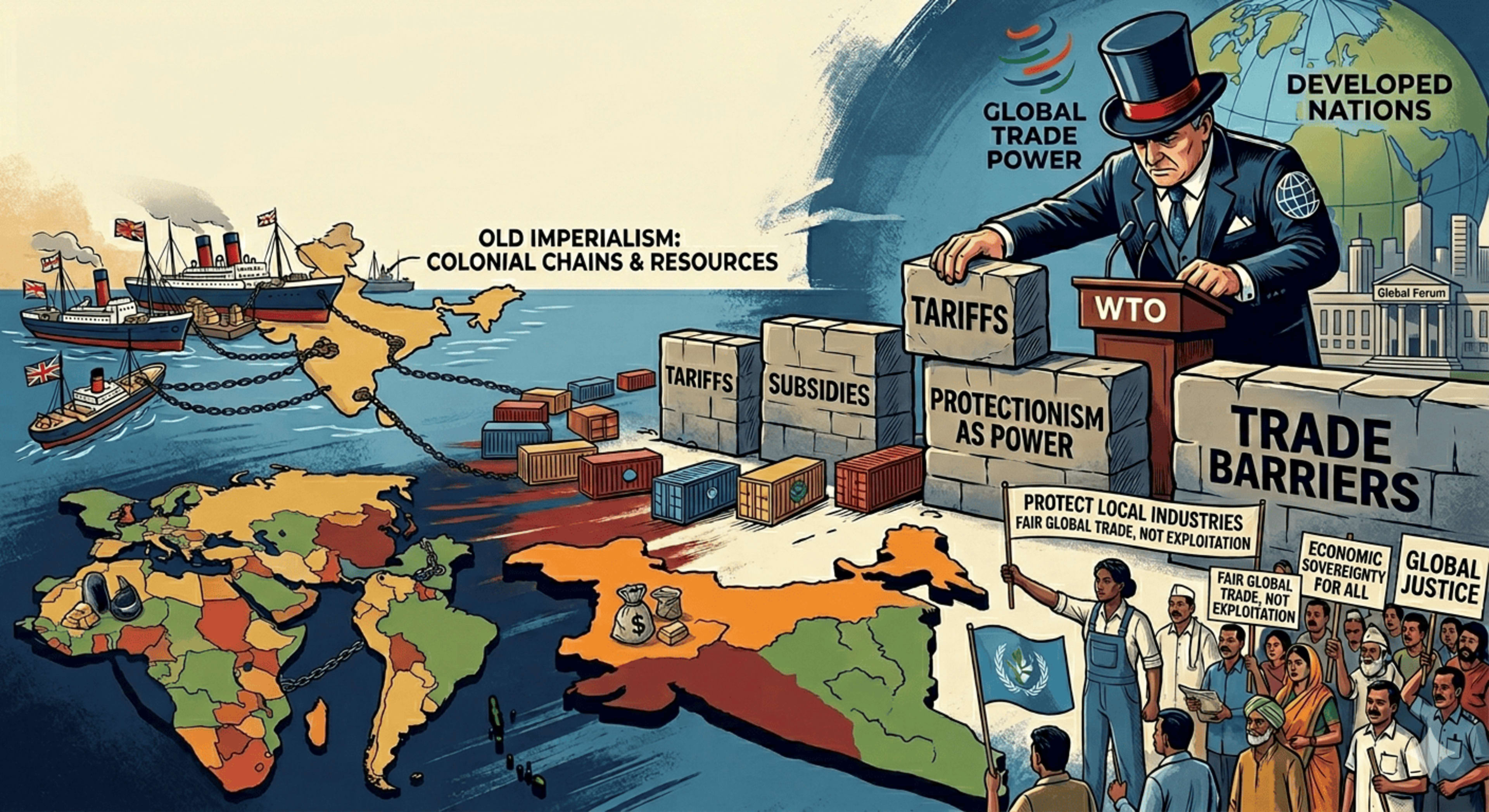
This dynamic recalls a troubling historical parallel: the
new world colonial order, but operating through tariffs rather than territorial
occupation. Just as colonial powers extracted wealth through direct control,
wealthy nations now weaponize trade rules to subordinate developing economies,
keeping them dependent and impoverished. The mechanism has changed; the logic
of domination remains.
The Failure of World Order
This collapse exposes a deeper crisis in the post-1945
international architecture. Institutions like the WTO and the UN Security
Council were designed on a single principle: all sovereign nations, regardless
of size or power, deserve equal standing. The reality is radically different.
The law of the jungle now governs international relations, where superpowers
like the United States disregard the sovereignty and rights of weaker nations
with impunity. The human rights frameworks, free trade agreements, and collective
security mechanisms established to prevent future atrocities have become mere
performance, observed only when convenient for dominant powers.
What This Means: The Global South Rises
India's WTO action is not merely a trade dispute. It is a
statement that the current international order—built on principles it
systematically violates—lacks legitimacy. It is also a turning point. For
decades, the Global South has absorbed the consequences of a rigged system
designed by and for the Global North. Until institutions like the WTO enforce
their mandates fairly and demand accountability from powerful nations, the gap
between their stated purpose and actual function will continue to undermine global
justice and stability.
But India's stance represents something more: the Global
South finally articulating what has long been true—that genuine prosperity and
peace require genuine equity. The Earth is not divided into rulers and ruled;
it is shared by North and South, developed and developing nations. Fair trade
is not charity; it is the foundation upon which a sustainable, legitimate
international order must be built. Without it, the cycle of coercion,
resentment, and instability will continue. With it—with true reciprocity and respect
for sovereignty—lies the possibility of a world where growth and justice are
shared, not hoarded.