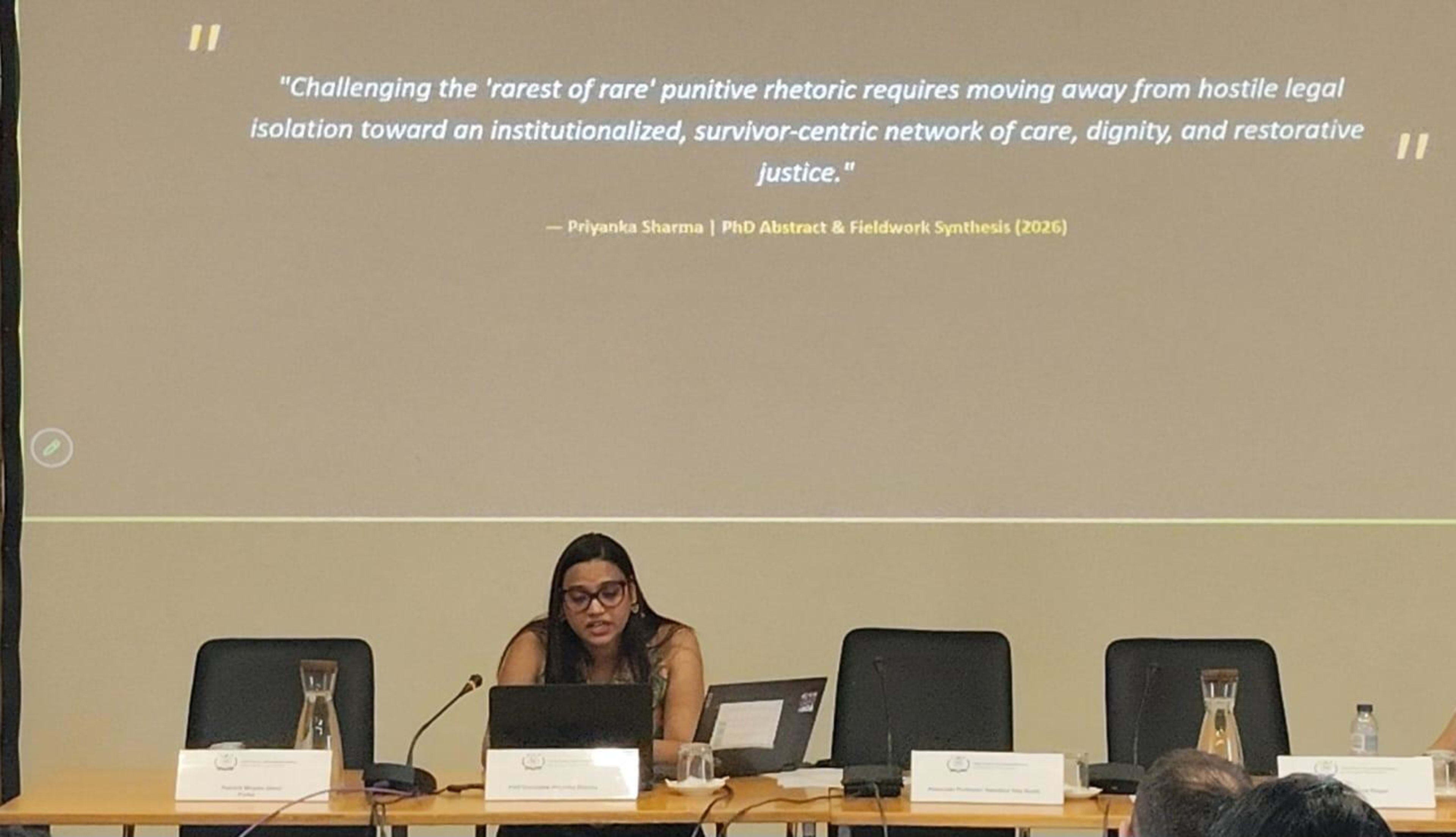
Recently, I presented my research,
“Dual Victimization and Systemic Barriers: An Intersectional Analysis of Access
to Justice for Rape Survivors in Delhi, India,” at the International Conference
on Critical Theory, International Relations and European Union Studies at the
University of Évora, Portugal.
During the presentation, I was
asked an important question: Do you think there have been changes after the
2013 anti-rape law? This question made me reflect on the difference between
statutory law and its implementation on the ground. My research focuses on the
experiences of survivors and their interaction with service providers. Through
my recent fieldwork in Delhi, I have been examining whether survivors actually experience the legal provisions as intended.
The discussion becomes even more
important when we look at recent incidents of sexual assault in Delhi and the
surrounding region.
A recent case involved a girl who
was allegedly raped in a moving bus, and the incident was also reported as a
gang rape. This immediately brought to mind the 2012 Nirbhaya case, where the
sexual assault also took place inside a moving bus, late at night.
In the span of fourteen years, has anything really changed for women's safety?
There have certainly been changes
in the statutory law. The Criminal Law (Amendment) Act, 2013, known as the Anti-Rape Law, brought important changes to the legal framework dealing with sexual
violence.
The definition of rape was
broadened. It moved away from the earlier narrow understanding of rape and
recognised non-consensual penetration involving different parts of the body or
objects. The law also criminalised new offences, including stalking under
Section 354D, voyeurism under Section 354C, acid attacks under Sections 326A
and 326B, and disrobing under Section 354B.
There were also important provisions concerning the treatment of survivors. The use of invasive practices such as the two-finger test was strongly rejected, and the importance of dignified medical care for survivors was emphasised. There was also an important provision relating to police accountability through Section 166A of the IPC, which provides punishment for public servants who fail to perform certain duties relating to sexual offences, including refusing to register an FIR in specified circumstances.
Apart from these legal provisions,
there were also preventive measures concerning public transport. Buses were not
supposed to have dark or black glasses or curtains covering the windows, and
the police were responsible for checking such violations.
What happened in these fourteen years? Where was the police that was responsible for checking these things?
These measures were not only
intended to respond to a rape after it happened. They were also precautionary
measures intended to prevent such incidents from happening in the first place. This
distinction is important. The responsibility of the police and other
institutions should not begin only after a woman has already been sexually
assaulted. Prevention and implementation of existing rules are equally
important.
During my fieldwork in Delhi for my
PhD research, I heard Delhi Police personnel saying that Delhi Police is doing
its best and is one of the most active police forces when it comes to cases of
sexual assault. But is this really the case? When we look at recent incidents
of sexual assault, it raises questions about how effectively these preventive
measures are actually being implemented.
This was also connected to another
question I was asked during my paper presentation: Do you think sexual
assault is a behavioural problem in Delhi?
My answer was yes. Sexual assault
is certainly a behavioural issue. It is connected to the behaviour of
individuals and the wider social environment.
But the question cannot end there. We
also need to ask: What happens to the law when it is actually needed? If laws
and regulations are already in place, are they being implemented properly?
During my fieldwork, when I asked
questions about why certain things were not working properly, one of the
answers that I repeatedly encountered was: “We are overburdened.”
If the institutions responsible for implementation are overburdened, then whom do we question? Who is responsible for ensuring that the law works in practice?
This is where the difference
between statutory law and implementation becomes important.
The law can provide rights and
protections on paper. The 2013 anti-rape law brought significant changes to the
legal framework. But my research is concerned with what happens when these
legal provisions meet the everyday experiences of survivors and their
interactions with service providers.
The recent incident of rape on a
moving bus, fourteen years after Nirbhaya, therefore made me reflect again on
this gap. The question is not simply whether the law has changed. The law has
changed. The question is whether its implementation has changed to the same
extent. Because ultimately, a law can exist on paper, but its real meaning for
a survivor depends on what happens when she actually enters the system and
seeks help.
This is the issue that emerged
repeatedly through my fieldwork and through my recent academic discussions: the
difference between statutory protection and protection experienced in practice.
And perhaps this is the question that we need to continue asking:
Fourteen years after Nirbhaya, have
we only changed the law, or have we also changed the way that law is
implemented?